If you’ve just discovered pickleball — at a community centre, a friend’s backyard, or through one of the hundreds of clubs that have popped up around the country — you’ll quickly realise that borrowing someone else’s paddle only gets you so far. Owning your own changes the game. You know the weight, the grip, the feel. You can practise consistently and actually track your improvement.
The problem is that the paddle market has exploded. Walk into a specialist retailer or scroll through an online store and you’ll find dozens of options at wildly different price points, most of them using buzzwords that don’t mean much to a new player. This guide cuts through that noise and gives you honest, practical advice on what to look for — and what to buy — at every level.
What Actually Matters in a Pickleball Paddle
Before getting into specific recommendations, it helps to understand the three variables that affect how a paddle performs.
Core material is the biggest factor. Most paddles today use a polymer honeycomb core, which gives a softer feel, better control, and a quieter pop — ideal for venues that have noise restrictions, which covers a surprising number of Australian courts. Nomex cores are harder and faster but much louder and less forgiving. For most players, polymer is the right starting point.
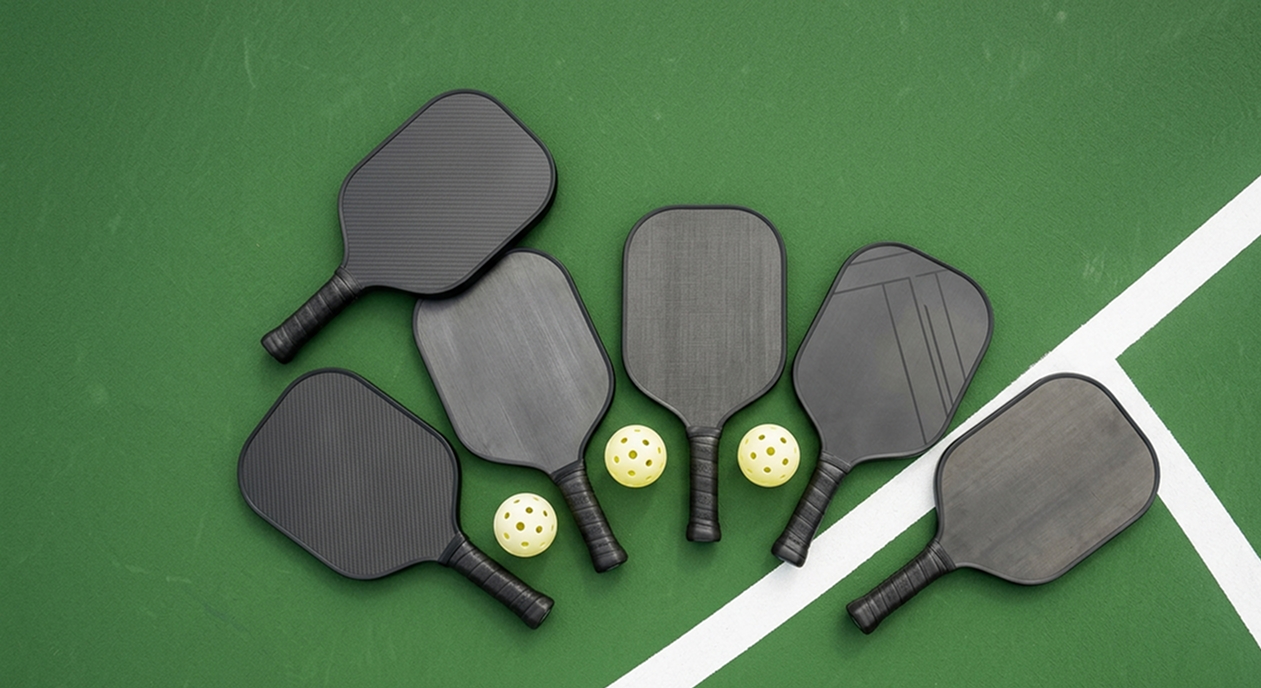
Surface material determines spin and touch. Fibreglass (also called fibreglass composite) is the most common surface on mid-range paddles. It has a slight flex that adds power and is forgiving on off-centre hits. Carbon fibre surfaces are stiffer and textured, generating more spin but rewarding cleaner technique. Beginners generally do better with fibreglass; players who’ve been at it six months or more often prefer carbon.
Weight is the most misunderstood spec. Heavier paddles (roughly 230g and up) drive the ball more easily and are good for singles or baseline play. Lighter paddles give you faster hands at the kitchen line, which matters enormously in dinking exchanges and doubles. A mid-weight paddle in the 210–225g range is where most intermediate players land, and it’s a sensible starting point for anyone unsure.
Grip size is personal — standard and large are the two most common options in Australia. If you’re between sizes, go smaller: you can always build up a grip with overgrip tape, but you can’t shrink one.
Best Beginner Paddles (Under $80 AUD)
At this price point, the goal is simple: get something serviceable that won’t frustrate you as you’re learning. You don’t need a paddle with a raw carbon face and an aerospace-grade core. You need something that feels like it belongs in your hand, won’t give you elbow pain after an hour, and handles a wide range of shots reasonably well.
Selkirk and Onix both offer entry-level composite paddles in this range through Australian retailers and major online marketplaces. Paddle brands like Prolite and Diadem have also expanded their Australian distribution in 2025–2026, making decent entry-level options more accessible than they were a few years ago.
What to look for: a fibreglass or graphite face, a polypropylene honeycomb core, a grip circumference around 4–4.25 inches, and a weight between 200–225g. Avoid paddles that feel noticeably hollow or plasticky — that usually means a low-density core that deadens the ball rather than absorbing impact properly.
Many clubs and community courts across Australia offer loaner paddles for your first few sessions, which is worth doing before you commit to buying. Check the listings directory to find courts near you that run open-play sessions where loaners are typically available.
Mid-Range Paddles ($80–$180 AUD)
This is where pickleball paddles get genuinely good. In this bracket, you’ll find paddles from Joola, Head, Wilson, Engage, and the popular Selkirk Sport mid-range lineup. These are paddles used by committed recreational players and club-level competitors.
The Joola Ben Johns Hyperion, available in Australia through specialist retailers for around $130–$160 AUD, has been a standout recommendation for two years running. It uses a carbon abrasion surface over a Reactive Honeycomb Polymer core, which gives it excellent touch at the net and enough pop for driving from the baseline. It’s not the most forgiving paddle if you’re still finding your swing, but if you’ve been playing a few months and want to level up, it’s hard to beat at this price.
Engage paddles — particularly the Encore series — are worth serious consideration if you’re a control-oriented player. Engage uses a proprietary core material that genuinely does feel different from standard polymer, particularly on dinks and drops. They sit around $150–$180 AUD in Australia and hold up well over time.
For players who prioritise touch over power, Head’s Radical series offers a softer feel with plenty of spin capability from its textured surface. These are popular among players coming from a tennis background who want to leverage existing wrist and arm technique.
Performance Paddles ($180–$300+ AUD)
At the top end, you’re paying for marginal gains in specific areas — more spin from a raw carbon face, weight distribution optimised for pro-level play, or a particular balance point that suits aggressive net play. These paddles are worth considering if you’re playing competitively in state tournaments or training seriously.
The Selkirk Vanguard Power Air and the Joola Perseus are both available in Australia and sit in the $220–$280 range. Both have thermoformed construction, which stiffens the whole paddle (not just the face) for a more consistent feel across the entire hitting surface.
One caveat: several USAPA-approved paddles sold overseas have had approval issues when used in Australian Pickleball Association (APA) sanctioned events. If you’re buying for competitive play, confirm the paddle is on the APA approved list before purchasing. This mostly affects paddles with rough surface treatments that exceed spin-generation limits.
Paddles to Avoid
The budget end of the market on general marketplaces is filled with unbranded paddles from manufacturers with no real quality control. These typically have heavier-than-stated weights, thin grips that crack quickly, and core materials that don’t hold up. For $30–$40 less than a decent entry-level paddle, you end up with something that may actively slow your progress. Spend the extra money.
Where to Buy in Australia
Specialist pickleball retailers have expanded significantly in the last two years, with stockists now operating in Sydney, Melbourne, Brisbane, Perth, and Adelaide. Most offer demo paddles in-store, which is genuinely the best way to make a decision — ten minutes hitting with a paddle tells you more than any spec sheet.
Online, Australian Pickleball Store, Pickleball HQ Australia, and several tennis retailers with expanded pickleball sections all carry the major brands. Check for Australian stock rather than ordering from the US — import duties and return shipping if there’s a warranty issue aren’t worth it.
Making the Right Choice
Most new players overthink the paddle decision and underthink the decision to play consistently. The best paddle is the one you actually pick up. If you’re within your first three months of playing, spend $80–$120, get something with a fibreglass face and polymer core, and focus on time on court.
If you’ve been playing for six months and are showing up to your local club two or three times a week, that’s the right time to invest in a mid-range carbon paddle that matches your emerging style — power game or touch game, baseline or kitchen.
The fastest way to improve isn’t a better paddle anyway. It’s finding courts with regular social play where you’re always matched against players slightly better than you. Browse the directory to find open-play sessions, club nights, and coached programs near you — and bring whatever paddle you have.