Competitive pickleball in Australia has matured rapidly over the past two years. What started as a handful of grassroots round-robins held on repurposed tennis courts has evolved into a structured national circuit, with sanctioned state championships, open invitationals, and a growing calendar of club-run events that give newer players a genuine pathway into competition. If you’ve been playing socially and feel ready to test yourself, 2026 is an excellent year to make the jump.
How the Australian Tournament Structure Works
Pickleball Australia (the national governing body) recognises tournaments at three broad tiers. National events sit at the top — the Australian National Championships and major open invitationals that attract interstate and international competitors. Below that are state championships, typically run by each state’s peak body and used to select representative players. At the base of the pyramid are sanctioned club tournaments, which are open to all skill ratings and genuinely welcoming to first-timers.
Most organised tournaments use the DUPR (Dynamic Universal Pickleball Rating) system, which assigns every player a rating between 2.0 and 8.0 based on match results. If you’re new to competition you’ll likely start in the 2.5–3.5 bracket. Many events also offer an “unrated” or “beginner” division so that players without a DUPR score can still participate.
National-Level Events in 2026
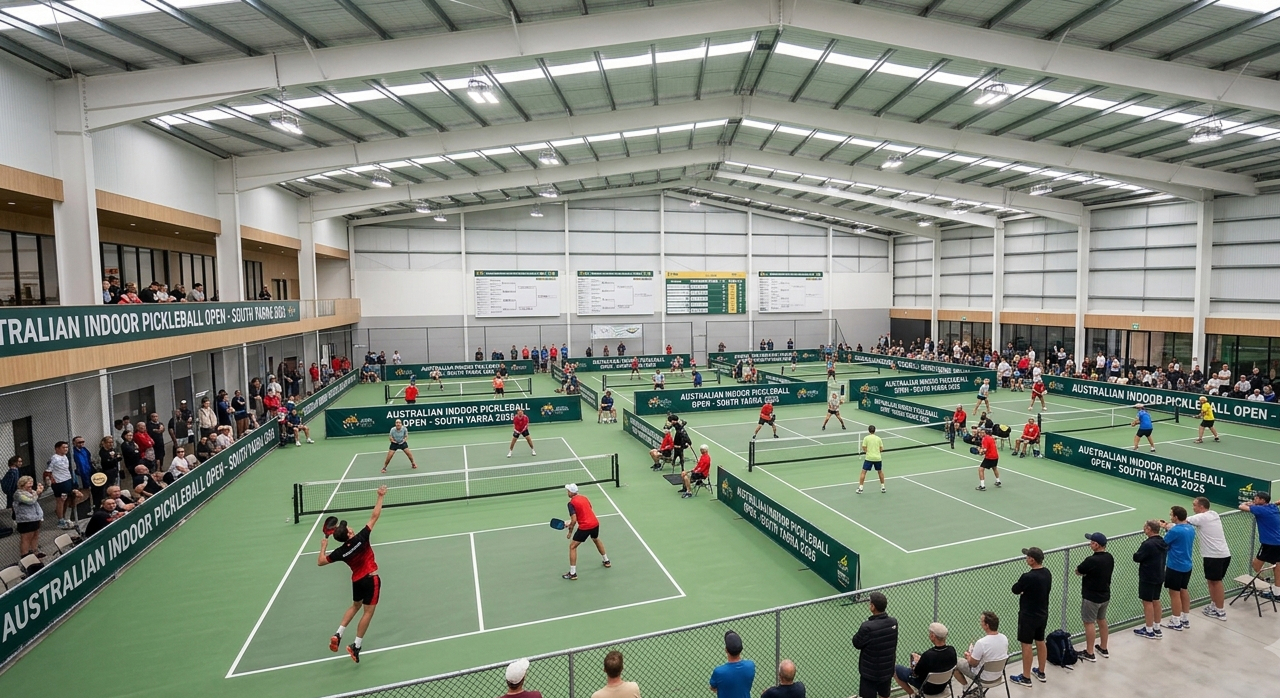
The Australian Pickleball National Championships is the headline event on the domestic calendar, typically held in the first quarter. In recent years it has rotated between Queensland and New South Wales, drawing players from every state and territory, as well as competitors from New Zealand and Southeast Asia. Expect multiple courts — recent editions have used 16-court dedicated pickleball facilities — with divisions across mixed doubles, men’s doubles, women’s doubles, and singles for age brackets from 19+ through to 70+.
Registration fees for nationals typically run between $80 and $140 per player depending on how many events you enter. Accommodation packages are often negotiated through the organising club, which helps keep costs manageable if you’re travelling.
The Open Series events, held in rotating capital cities throughout the year, operate as semi-independent invitationals that feed into national rankings. These are great stepping stones between club competition and nationals — the field is competitive but the atmosphere is generally more relaxed than the championship itself.
State Championships: Your First Competitive Target
For most players, a state championship is the realistic first goal. Here’s what the 2026 calendar typically looks like across the country:
- Queensland State Championships — traditionally held in late February or early March around the Brisbane/Gold Coast corridor, drawing the largest fields given Queensland’s size and the sport’s density there.
- NSW State Championships — usually run in autumn, often across venues in Greater Sydney and the Central Coast region.
- Victorian State Championships — Melbourne’s competitive scene has grown substantially; the state champs have attracted 200+ competitors in recent years and are typically held mid-year.
- South Australian Championships — Adelaide’s community is tight-knit and the event is known for its friendly atmosphere, making it particularly accessible for newer competitors.
- Western Australian Championships — Perth events often see strong participation from players who can’t easily travel east, and the WA community has invested in permanent court infrastructure that hosts competitive play year-round.
Specific dates for each state event are published by the relevant state body, so it’s worth joining your local club’s mailing list or checking Pickleball Australia’s event page as the season approaches. Dates can shift by a few weeks from year to year.
Club Tournaments: Where Most Players Start
Sanctioned club tournaments are the entry point for the overwhelming majority of competitive players, and rightly so. They’re lower-stakes, cheaper to enter ($25–55 is common), and run across a single day rather than a full weekend. Most clubs run at least two or three of these per year.
The formats vary — round-robin pool play followed by a short knockout bracket is standard — but some clubs run “hat” or “social” tournaments where partners are drawn randomly, which is a fantastic way to meet players outside your usual circle. These events are particularly good for players who are confident in social play but haven’t yet competed in a structured draw.
What makes club tournaments useful beyond the competition itself is the feedback loop they create. Playing against people outside your regular group exposes gaps in your game that social play often masks. You’ll quickly learn, for example, whether your third-shot drop holds up under pressure or whether your dinking consistency is genuinely solid or just a product of playing against familiar opponents.
How to Enter Your First Tournament
The process is more straightforward than most beginners expect. The broad steps are:
- Get a DUPR account. It’s free to register at mydupr.com. Your rating will populate after your first sanctioned matches, and some clubs can add social match results to give you a starting point.
- Find a sanctioned event. Pickleball Australia maintains an event calendar; so do state bodies. Club newsletters are another reliable source.
- Register early. Popular divisions at major events fill up quickly — nationals can cap entries for specific age brackets within days of registration opening.
- Arrive with the right gear. Most tournaments require an approved paddle (check the USA Pickleball approved paddle list, which Australian tournaments typically reference). Bring multiple balls if you have them, comfortable court shoes, sun protection, and plenty of water. If you’re playing outdoors, Australian summer tournaments can be demanding even with early start times.
What to Expect on the Day
Club tournaments typically run from around 8:00 am to 4:00 pm, though larger events with multiple divisions can stretch into early evening. You’ll usually warm up in your own time before play begins, so arriving 30–45 minutes early is sensible.
Referees may or may not be present depending on the event tier — many club tournaments use self-officiating with a referee available for disputes. Larger sanctioned events and nationals will have trained officials at courtside. Scorekeeping is done on paper or via a tournament app (Pickleball Brackets and RoundRobin.co are commonly used in Australia).
Expect the atmosphere at club level to be genuinely encouraging, even at competitive events. Australian pickleball culture has inherited much of tennis’s tradition of players calling their own lines honestly, and the community is notably welcoming to newcomers who show up prepared and play in the spirit of the game.
Building Your Competitive Season
Rather than jumping straight into nationals or state championships, most coaches recommend building a competitive season deliberately: start with one or two club tournaments to get comfortable with the format, then attempt a state championship, then assess whether nationals is the right next step. A season structured this way gives your DUPR rating time to settle into an accurate range, which means you’ll be competing in the right divisions rather than being outclassed or under-challenged.
Off-tournament, your development will accelerate fastest through structured drilling and coached sessions. If your current club doesn’t offer coaching or has limited court time for practice, it’s worth exploring other facilities nearby — many dedicated pickleball venues offer drill sessions separate from social play.
Where to Find Courts for Tournament Prep
Training volume matters. Players who compete successfully in state championships are typically getting four to six hours of court time per week, including both social play and deliberate practice. Finding courts with the right availability — especially dedicated pickleball courts rather than shared multi-sport surfaces — can make a real difference to how efficiently you improve.
The Pickleball Australia court directory lists dedicated and shared courts across the country, filtered by state, suburb, and features like indoor/outdoor, lighting for evening play, and coaching availability. If you’re preparing for competition and need consistent court time, browsing courts in your area is a practical starting point.
For players in major cities, the metro-area listings show which venues have the highest court counts and regular competitive sessions — factors worth prioritising when you’re in tournament prep mode.
The tournament pathway in Australia is genuinely accessible right now, at a point in the sport’s growth where the competitive field is deep enough to be meaningful but not yet so crowded that entry is difficult. If you’ve been playing socially and the competitive itch is there, 2026 is a good year to scratch it. Start with your local club’s next sanctioned event, get your DUPR rating established, and build from there.