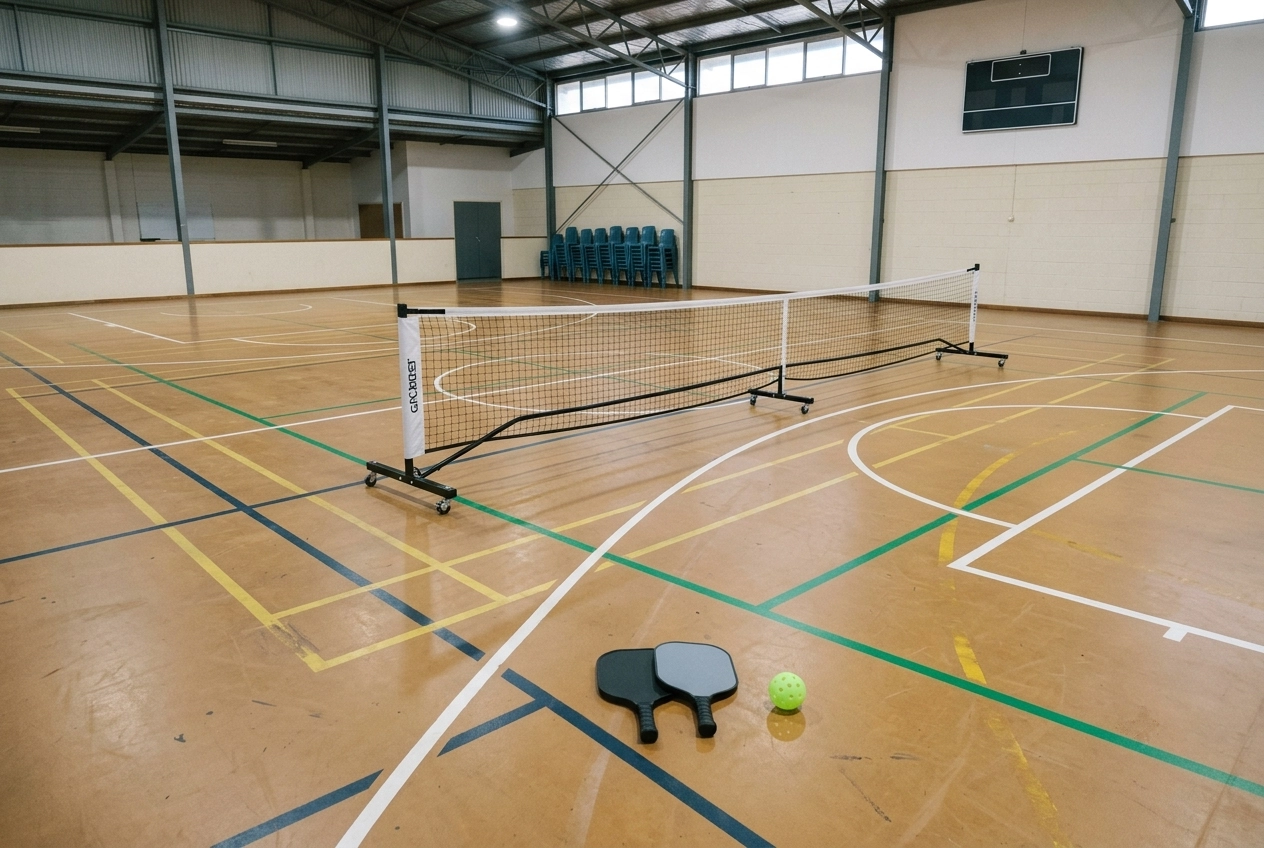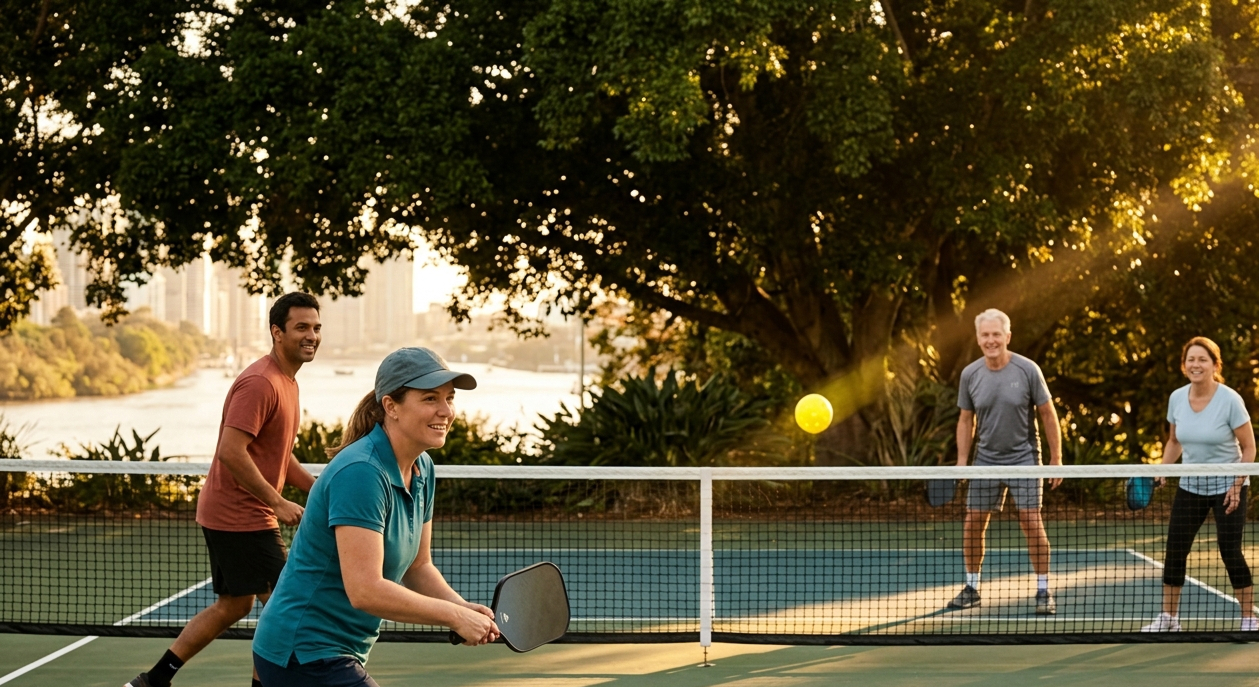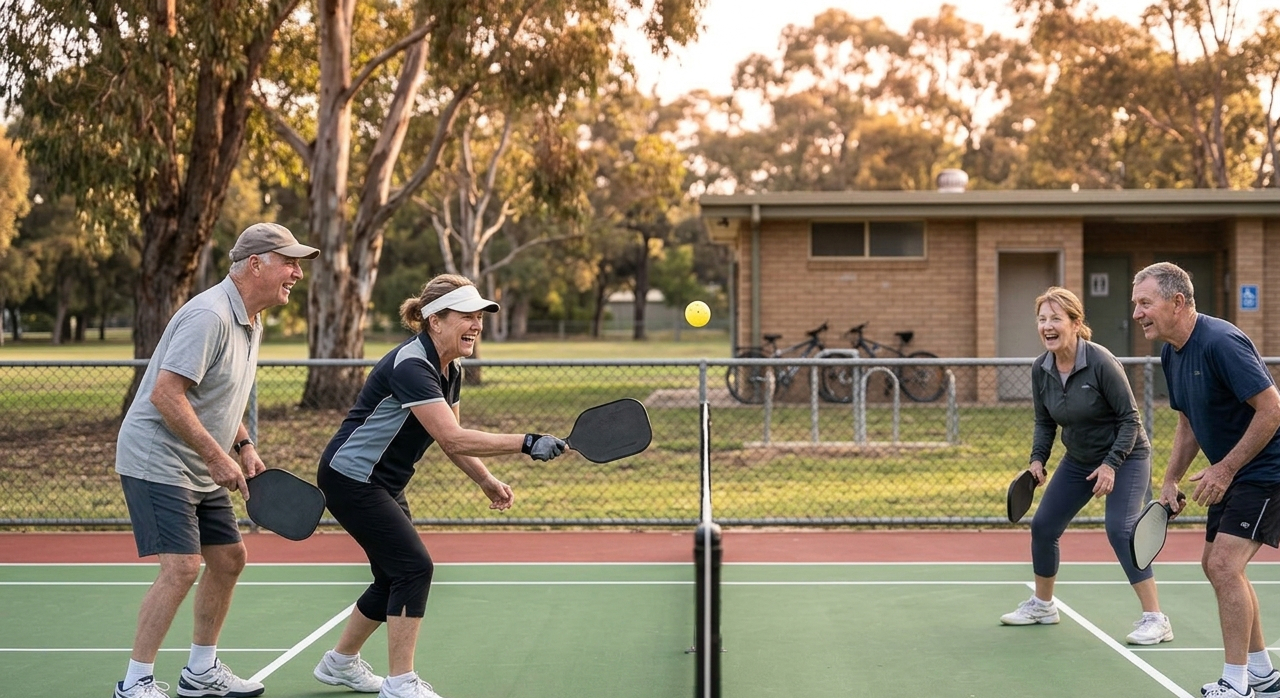

A pickleball court is smaller than most people expect, which is part of why the sport spreads so quickly through tennis clubs, school halls and community centres across Australia. Knowing the exact dimensions and line markings makes it much easier to play properly, set up a temporary court or judge whether a venue near you is worth the drive. Here is everything you need to measure, mark and start playing.
The official court dimensions
A regulation pickleball court is 20 feet wide and 44 feet long, which works out to 6.1 metres by 13.4 metres. Those are the same measurements for both singles and doubles, so you never adjust the court when you change format. These are the dimensions used in sanctioned play by the national governing body, Pickleball Australia (pickleballaus.org).
The playing surface should sit inside a larger total area to give players room to move and chase balls. A recommended total area is around 30 feet by 60 feet (roughly 9.1 m by 18.3 m), though many casual and converted courts use less. If you are setting up at home, more run-off space is always better and safer.
That small footprint is exactly why Australia’s dedicated centres can pack so many courts under one roof or onto one block. Pickleball Hervey Bay in Pialba runs 21 courts across indoor and outdoor areas, Pickle Point in Milperra fits 12 outdoor courts on its site, and Perth Pickleball Centre in Wanneroo houses 9 courts indoors. Try doing that with tennis courts.
Where the lines go
The court is divided by a handful of lines, and each one has a job:
- Baselines run across the back of the court, parallel to the net, at each end.
- Sidelines run the full length of the court down each side.
- Centreline splits each half into two service courts, running from the baseline up to the non-volley zone.
- Non-volley zone line sits 7 feet (2.13 m) back from the net on each side.
Standard line width is 2 inches (about 5 cm), and lines are measured from the outside edges. Service courts are formed by the centreline, sideline, baseline and the non-volley zone line.
The non-volley zone (the kitchen)
The non-volley zone, almost always called the kitchen, is the 7-foot (2.13 m) strip on each side of the net, spanning the full width of the court. You cannot volley the ball (hit it out of the air) while standing in the kitchen or touching its line. This rule stops players camping at the net and smashing everything, and it shapes much of pickleball strategy.
Net height
The net is set to 36 inches (91 cm) high at the sidelines and 34 inches (86 cm) at the centre. The slight dip in the middle is intentional and matters more than it sounds, because shots over the centre clear a lower barrier. If you are using a portable net, check the centre height with a tape measure, since many nets sag once they are under tension.
How it compares to tennis and badminton
The size difference is the first thing tennis players notice.
- A tennis court is 78 feet long and 36 feet wide for doubles (about 23.8 m by 11 m). A pickleball court fits comfortably inside it, which is why one tennis court can be converted into multiple pickleball courts.
- A badminton court is almost the same footprint as a pickleball court at 20 feet by 44 feet, which is no coincidence: pickleball borrowed badminton’s dimensions. The big difference is net height, since a badminton net sits much higher at around 5 feet.
The smaller court means less ground to cover, shorter running rallies, and a game that suits a wide range of ages and fitness levels.
What purpose-built courts look like in Australia
Dimensions are only half the story; the surface underneath changes how the ball bounces and how your knees feel afterwards. Purpose-built venues in our directory use proper sports surfaces rather than bare concrete. Pickleplex Pickleball in Ravenhall, in Melbourne’s west, has 4 indoor courts laid with Rebound Ace, the cushioned acrylic surface used at major tennis venues. Pickle Point’s 12 outdoor courts in Milperra are surfaced with Greenset Cushion and lit for night play, with casual court hire at $20 per hour on weekdays before 6pm, rising to $30 per hour after 6pm and on weekends.
Across the rest of the directory you will find hard court, Plexipave, concrete and timber sports-hall floors. Cushioned acrylic surfaces are the gold standard for outdoor play, while indoor timber is common at venues sharing space with basketball and netball. If a bouncy, consistent surface matters to you, it is worth checking the listing before you book.
Free line-marked public courts
You do not need a dedicated centre to play on proper lines. A growing number of councils have painted permanent pickleball markings on public courts, and play is free. McCook Park Pickleball Courts in Newmarket, Brisbane, has two outdoor hard courts with parking and toilets nearby, and Docklands Sports Courts in Melbourne offers two free courts a short walk from the city.
One thing to know about public courts: the lines are usually permanent but the nets often are not. Pack a portable net if you are not sure what you will find, and check the venue’s listing page for details before you head out.
Setting up a temporary or portable court
If there is no marked court near you, a flat, hard, non-slip surface is the main requirement. A driveway, basketball half-court, netball court, car park or large garage floor can all work.
What you will need:
- A portable pickleball net set at the correct heights (36 in / 34 in).
- A tape measure (a 30 m builder’s tape is ideal).
- Court tape, chalk, or removable line markers for the boundaries and kitchen.
- A few witches hats or markers if you cannot draw full lines.
A simple way to mark it out:
- Measure and mark the four corners of the 20 ft by 44 ft (6.1 m by 13.4 m) rectangle.
- Run tape or chalk along the baselines and sidelines.
- Measure 7 feet (2.13 m) back from where the net will sit on each side and mark the kitchen lines.
- Set the centreline from each baseline up to the kitchen line.
- Position the net across the middle and check both heights.
For temporary surfaces, painter’s tape or gaffer tape holds up well indoors, while outdoor chalk works for a casual session. Removable vinyl line markers are reusable and pack down small.
Converting a tennis court
Tennis courts are the most common conversion in Australia because the surface is already suitable. You have two practical options:
- Use the existing net post area: a single tennis court can usually fit one pickleball court across the middle, or two side by side if there is room, by adding portable nets and taping pickleball lines.
- Use blended lines: many clubs paint pickleball lines in a contrasting colour over the tennis surface so both sports share the court.
Always check with the club or council before marking anything on a shared court. Painter’s tape is the safe, removable choice for a one-off game.
Find a court that is already marked
Once you understand the dimensions, the lines and the kitchen, setting up a court at home becomes a half-hour job. If you would rather skip the tape measure, browse the full court directory or open the interactive map to find a venue near you with proper lines and nets already in place.