
Starting pickleball does not require a trolley full of equipment. A handful of well-chosen items will get you onto a court comfortably and safely, and you can let your kit grow as your game does. Here is what genuinely matters for your first few months, what a session costs before you spend a cent on gear, and what can wait.
Try a session before you buy anything
The cheapest way to start pickleball is to spend nothing on gear at all. Most dedicated venues hire out paddles and supply balls, so your first few outings can cost less than a takeaway lunch. Some real numbers from Australian venues:
- Perth Pickleball Centre in Wanneroo charges $14 per 90-minute social session for non-members, dropping to $10 per session for its Tuesday and Thursday value sessions.
- Pickleball Hervey Bay runs social sessions at $10 per session for non-members, with paddle hire for $3 per session on top.
- Dink & Drive Pickleball Club in Port Melbourne charges $25 per session for non-member social play, and hires paddles at $5 per person per session.
Paddle hire is common wherever a listing shows equipment rental. Level Up Pickleball Knox City in Wantirna South hires paddles for $5 per session, free if you are a member, and Pickle Point in Milperra offers racquet and ball hire for $5 per session alongside casual court hire from $20 per hour on weekdays before 6pm. Plenty of venues also run sessions built for first-timers; Pickle Kit Pickleball in Mitchelton has a Come and Try Pickleball program and beginner practice sessions on both indoor and outdoor courts.
Two or three sessions on a hired paddle will teach you more about what you want in your own than any review will.
A paddle to start with
Your paddle is the one piece of gear worth a little thought, but you do not need an expensive one to begin. Pickleball paddles are solid with no strings, and most beginners are well served by a mid-weight paddle in roughly the 220 to 250 gram range, which balances control and power without tiring your wrist.
A few things to look for in a first paddle:
- A comfortable grip. Your hand should close around the handle with a small gap between fingertips and palm. Too small causes slipping; too large strains the forearm.
- A larger sweet spot. Wider face shapes are more forgiving when you mishit, which you will do often early on.
- Reasonable weight. Very light paddles can feel twitchy; very heavy ones slow your reactions at the net.
Once you have hired a few different paddles at social sessions, you will know whether you prefer something head-heavy or balanced, and roughly what grip size suits you. That knowledge makes your first purchase far less of a gamble.
The right balls (indoor versus outdoor)
Pickleballs are hollow plastic with holes, and the two main types are not interchangeable. Buying the wrong ones is a common first mistake.
Outdoor balls
Outdoor balls are made of harder plastic and have smaller, more numerous holes, commonly around 40. The extra weight and rigidity help them hold a truer line in wind, which matters for most Australian play on outdoor hard courts. They feel firmer off the paddle and tend to bounce a touch faster.
Indoor balls
Indoor balls are softer, lighter and have fewer, larger holes, often around 26. They are gentler on the arm, sit up a little longer, and suit the smooth surfaces of sports halls. Used outdoors they get blown around easily.
If you mostly play outside, buy outdoor balls. If your local venue is a hall, get indoor ones. A pack of three or four is plenty to start, and check what your venue already provides, as most clubs supply balls for social sessions.
Playing free courts? Think about a net
Free council courts are the cheapest way into the sport of all, and there are more of them than you might expect. Brisbane has several, including McCook Park Pickleball Courts in Newmarket with two hard courts, and Melbourne has the free Docklands Sports Courts with two courts in the city.
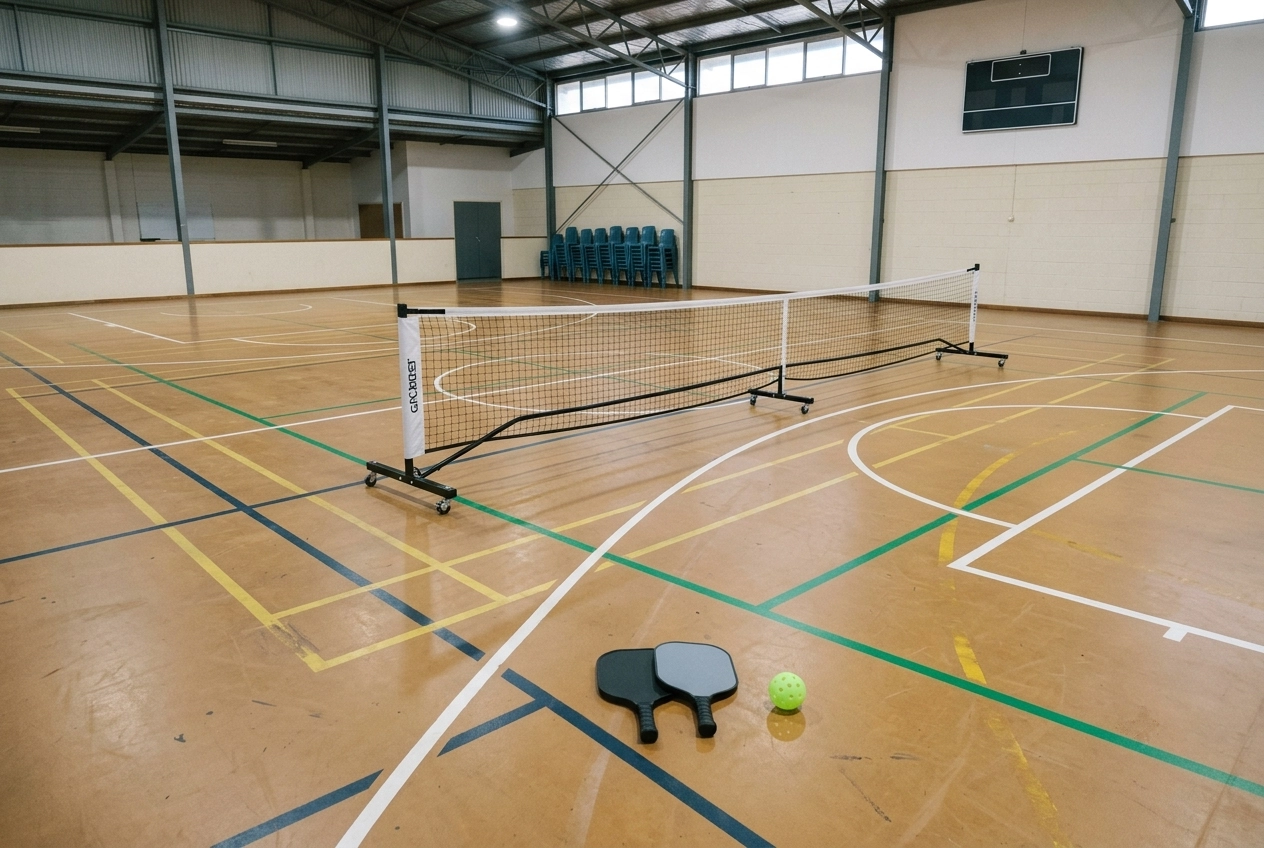
The catch is nets. Some free public courts have permanent nets, but many are line-marked only, and regulars turn up with a folding portable net that sets up in a few minutes. Check the venue listing before you head out; if the court relies on portable nets, either join a group that brings one or add a portable net to your shopping list once you know free courts will be your regular game. It is the one piece of gear on this list you might buy before a premium paddle.
Court shoes that support sideways movement
This is the item people most often overlook, and the one that prevents the most injuries. Pickleball involves quick lateral steps, sudden stops and pivots, so running shoes are a poor choice. They are built for forward motion and roll inward on side-to-side movement, which can turn an ankle.
Look for:
- Court shoes designed for tennis, netball or general indoor court sport, with reinforced sides for lateral support.
- Non-marking soles if you ever play indoors. Most halls require them, and many will turn you away without them.
- A flat, grippy outsole rather than the raised heel of a running shoe.
You do not need a pickleball-specific shoe. Any decent court shoe you already own for tennis or netball will do the job nicely. As for clothes, there is no dress code for social pickleball: your existing activewear, shorts or a skort and a breathable top cover it.
Sun and water for outdoor play
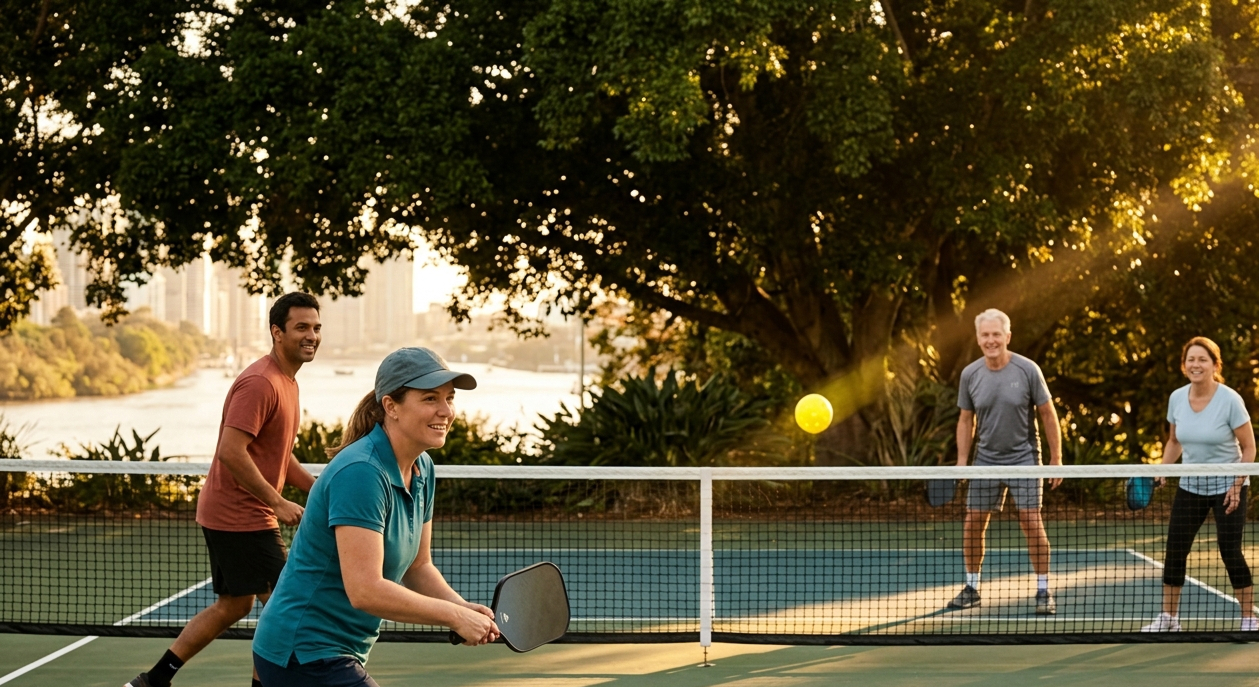
Australian conditions deserve real attention here. Outdoor courts offer little shade and the surface reflects heat, so a session can be hotter than it feels.
Pack the basics every time:
- Water, more than you think you need. A large refillable bottle and a top-up between games keeps you sharp and steady on your feet.
- Broad-spectrum sunscreen, applied before you start and reapplied on a long stint.
- A hat or visor and sunglasses for the glare, especially in the middle of the day.
- A light long-sleeve top if you burn easily; many quick-dry shirts now carry a sun rating.
Playing earlier in the morning or later in the afternoon also makes summer sessions far more pleasant.
What you do NOT need to buy yet
It is easy to spend money on things that will not improve your first months of play. Hold off on:
- A premium carbon-fibre paddle. You will not feel the benefit until your technique settles, and your preferences will likely change.
- Multiple paddles. One is enough until you understand what you like and dislike about it.
- A dedicated paddle bag. Any sports bag carries your gear fine.
- Grip tape, overgrips and accessories. Useful later, unnecessary on day one.
- Branded pickleball clothing. Your existing activewear is perfectly good.
Spend on shoes that protect you, get the correct balls for your venue, and keep the rest simple. As your game develops you will know exactly what is worth upgrading.
Get on a court
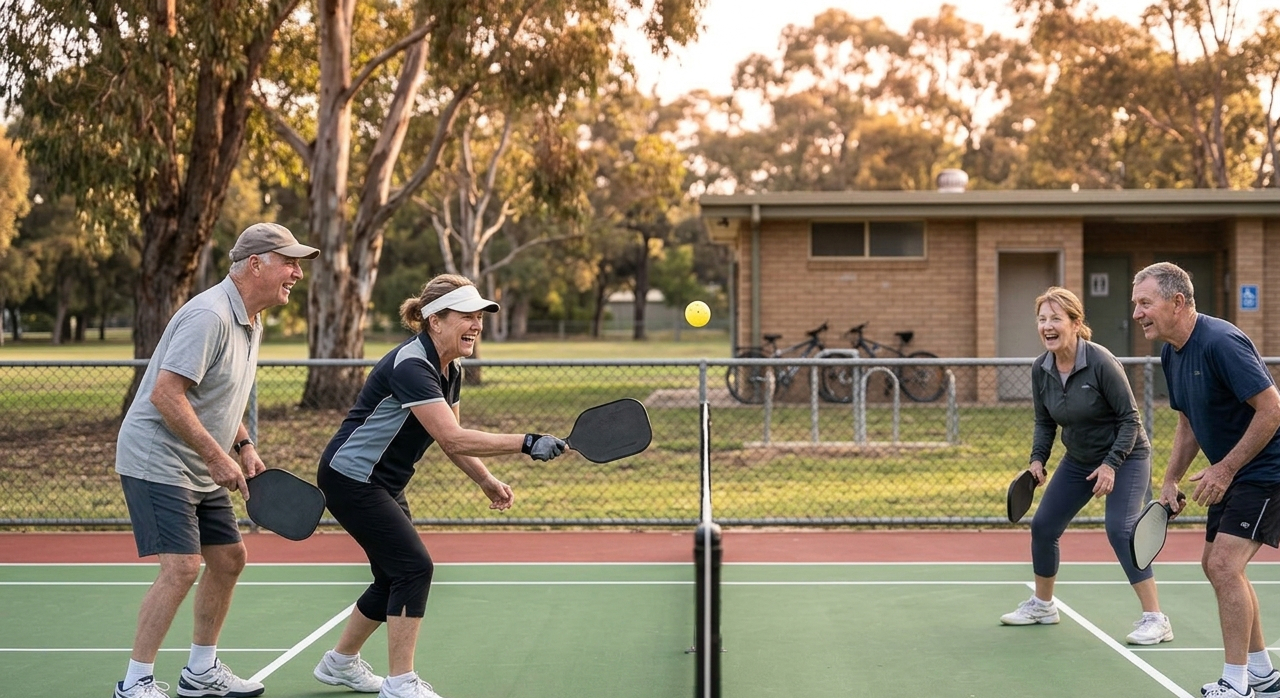
With a hired paddle, the right balls, supportive shoes and a bit of sun sense, you are ready to play. The fastest way to improve is to turn up and hit, ideally at a social session where people are happy to walk a newcomer through the two-bounce rule and the non-volley zone. Browse every venue in the court directory, or use the interactive map to find the nearest paddle-hire session or free court and book in this week.