
Three rules trip up almost every new pickleball player: the underhand serve, the kitchen and the two-bounce rule. Get those right and the rest of the game falls into place within a session or two. Here is a clear rundown of the core rules so you can step onto a court and play with confidence.
The court and the basics
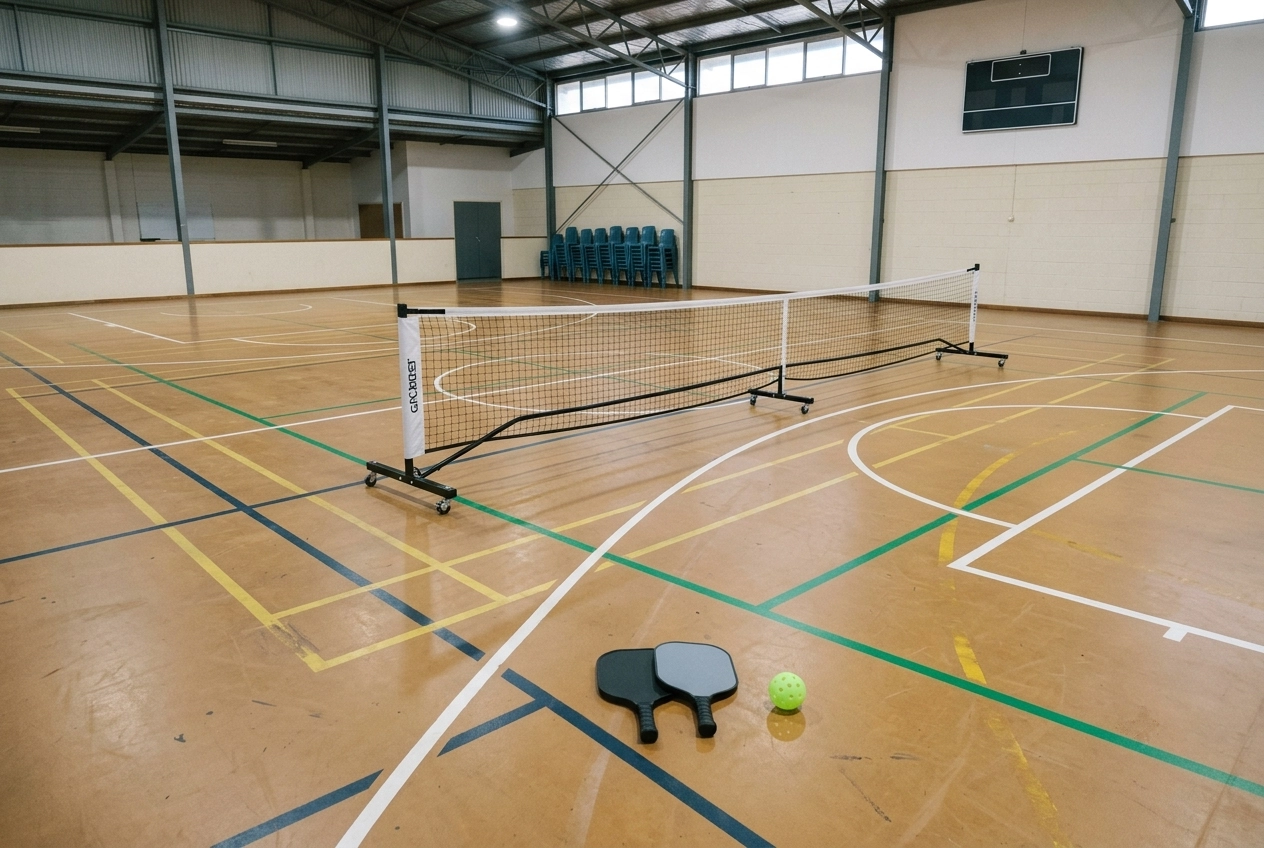
A pickleball court is 20 feet wide and 44 feet long (6.1 x 13.4 m), the same footprint as a doubles badminton court. The net sits at 36 inches (0.91 m) at the sidelines and dips to 34 inches (0.86 m) in the centre.
Games are usually played to 11 points, win by 2. In tournaments you may see games to 15 or 21, but 11 is the standard for social play. Only the serving side can score a point, which is why rallies often feel long and patient.
If you want the full court layout and how to set one up at home or at a local park, see our guide to pickleball court dimensions and setup.
The serve
The serve in pickleball is deliberately gentle. It is meant to start the rally, not win the point outright.
How to serve
- Underhand only. Your arm must move in an upward arc, and contact with the ball must be below your waist (defined as the navel level).
- Paddle head below the wrist. At the moment you strike the ball, the highest point of the paddle head must be below your wrist.
- Behind the baseline. Keep both feet behind the baseline at the moment of contact, and stay within the imaginary extensions of the centreline and sideline.
There is also a “drop serve” option, where you let the ball drop and bounce once, then hit it. With a drop serve the waist-height and upward-arc rules are relaxed, which is why a lot of beginners find it easier.
Where the serve goes
Serves are hit diagonally (cross-court) into the opposite service box. The serve must clear the net and the non-volley zone, landing in the correct diagonal court. A serve that lands in the kitchen or on the kitchen line is a fault.
Only one serve attempt is allowed per server. If you hit the net cord and the ball still lands in the correct service box, play simply continues (the old “let” replay was removed).
Serving order
- In doubles, both players on a team usually get to serve before the serve passes to the other team. The exception is the very first service turn of the game, where only one player serves.
- The server’s score determines which side they serve from: serve from the right when your score is even, and from the left when it is odd.
Scoring and the three-number call (your score, their score, and the server number) is its own topic. We cover it step by step in pickleball scoring explained.
The two-bounce rule
This is the rule that catches almost everyone at first. After the serve, the ball must bounce once on each side before anyone is allowed to volley (hit it out of the air).
So the sequence is:
- The server serves, and the ball bounces in the receiving court.
- The receiver returns the ball, and it bounces in the serving team’s court.
- From the third shot onwards, either side may volley or play off the bounce.
This is also called the double-bounce rule. It exists to stop the serving side from rushing the net and smashing the return, and it gives both teams a fair chance to get into the point. The practical effect is that the serving team’s third shot is often a soft “drop” into the kitchen so they can move forward safely.
The kitchen (non-volley zone)
The non-volley zone, almost always called the kitchen, is the area extending 7 feet (2.13 m) from the net on both sides, running the full width of the court.
The rule is simple to state: you cannot volley while standing in the kitchen or touching the kitchen line. A volley is any ball you hit out of the air before it bounces.
Things that count as a kitchen fault:
- Stepping on or over the kitchen line while volleying.
- Your momentum carrying you into the kitchen after a volley, even if you hit the ball cleanly and land in the kitchen a moment later.
- Touching the line with your paddle, hat or anything you are wearing as part of the volley motion.
What is allowed:
- Standing in the kitchen to play a ball that has already bounced.
- Stepping into the kitchen at any time, as long as you are not volleying.
You just need to fully re-establish yourself behind the line (both feet out, no lingering momentum) before you volley again.
Common faults
A fault ends the rally. The most common ones are:
- Hitting the ball out of bounds.
- Failing the two-bounce rule by volleying too early.
- Volleying from inside the kitchen or while touching the line.
- Hitting the ball into the net.
- An illegal serve (too high, wrong court, or foot on the line).
- Letting the ball bounce twice on your side before returning it.
Line calls
A ball that lands on any line is in, with one exception: a serve that touches the kitchen line is out. The receiving team makes the calls on their side of the net, and the standard etiquette is to give the benefit of the doubt to your opponent when you are not sure. For more on the unwritten rules of social play, see pickleball court etiquette.
Singles vs doubles
Most of the rules are identical, but a few differ:
- Serving position in singles is based purely on your own score: an even score serves from the right, an odd score from the left.
- There is no partner, so the second-server concept does not apply. You serve until you lose the rally, then your opponent serves.
- The court is the same size, which makes singles a more demanding workout because you cover it all yourself.
Doubles is the more common format socially, and it is where the kitchen and two-bounce rule really shape the tactics.
Where the rules come from in Australia
None of the rules above are local house rules. Pickleball here is overseen by the national governing body, Pickleball Australia (pickleballaus.org), which follows the international rulebook and sanctions tournaments around the country. So the serve, kitchen and two-bounce rules you learn at a social session are the same ones you would play under in a sanctioned event, in Australia or overseas.
Put the rules into practice
Reading the rules is one thing. They only stick once you have played a few games with people who call the score out loud and pull you up, gently, when you volley from the kitchen. Social and open-play sessions are built for exactly this: the organiser mixes the games, and most regulars are happy to explain a call. A few venues around the country that run them:
- Pickleball Palace Sunshine Coast in Buderim, QLD runs social (open) play in multiple daily sessions across its 7 courts, with paddle hire at $5 per session if you do not own one yet.
- Perry Park Recreation Centre in Alexandria, NSW has casual pickleball on Monday and Wednesday from 10am to 12pm (over 18s, excluding school and public holidays).
- Clifton Hill Tennis Club in Clifton Hill, VIC runs all-levels social pickleball across the week, including Friday evening and Sunday morning blocks.
- Perth Pickleball Centre in Wanneroo, WA grades its social sessions from beginner through to premier, and the Beginner Social Session runs mornings and evenings throughout the week.
If none of these are near you, browse the full court directory or open the interactive map to find social play close to home.