
Pickleball is one of the easiest racquet sports to pick up, which is a big reason our directory now lists more than 250 places to play across every Australian state and territory. The rules are simple, the court is small, and you can have a real rally within minutes of stepping on. This guide walks you through everything a true beginner needs: what the game is, the gear, how a point plays out, how scoring works, and how to find your first game.
What is pickleball?
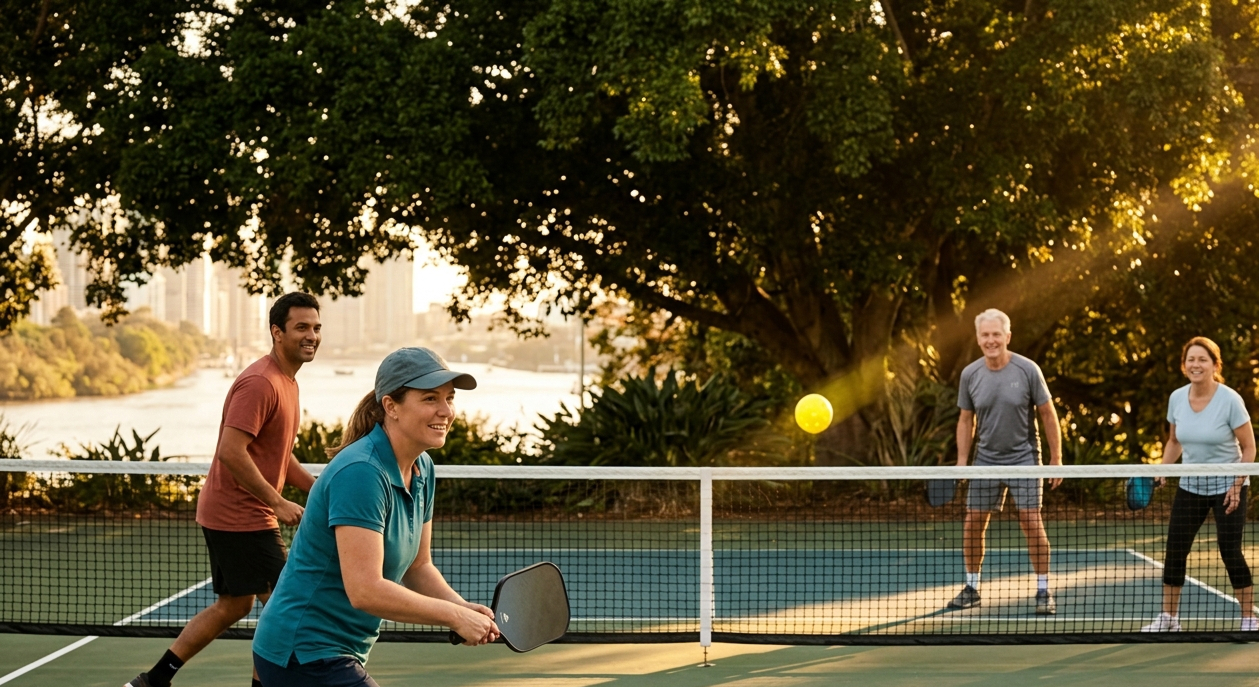
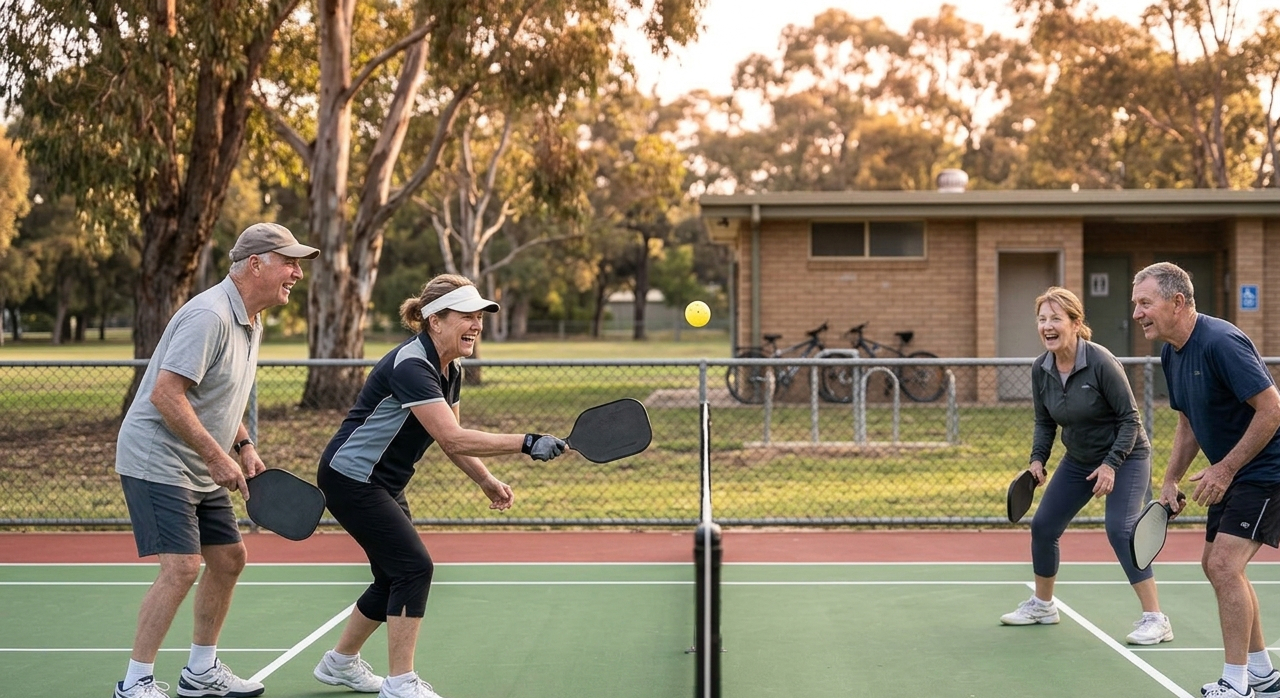
Pickleball is a paddle sport that borrows ideas from tennis, table tennis and badminton. You play on a court roughly the size of a badminton court, using solid paddles and a light plastic ball with holes in it. It can be played as singles (one against one) or doubles (two against two), though doubles is by far the most common and the most social.
The appeal is that the learning curve is gentle. The ball travels slower than a tennis ball, the court is smaller so you cover less ground, and rallies tend to last longer, which makes it forgiving for new players and easy on the joints.
The court
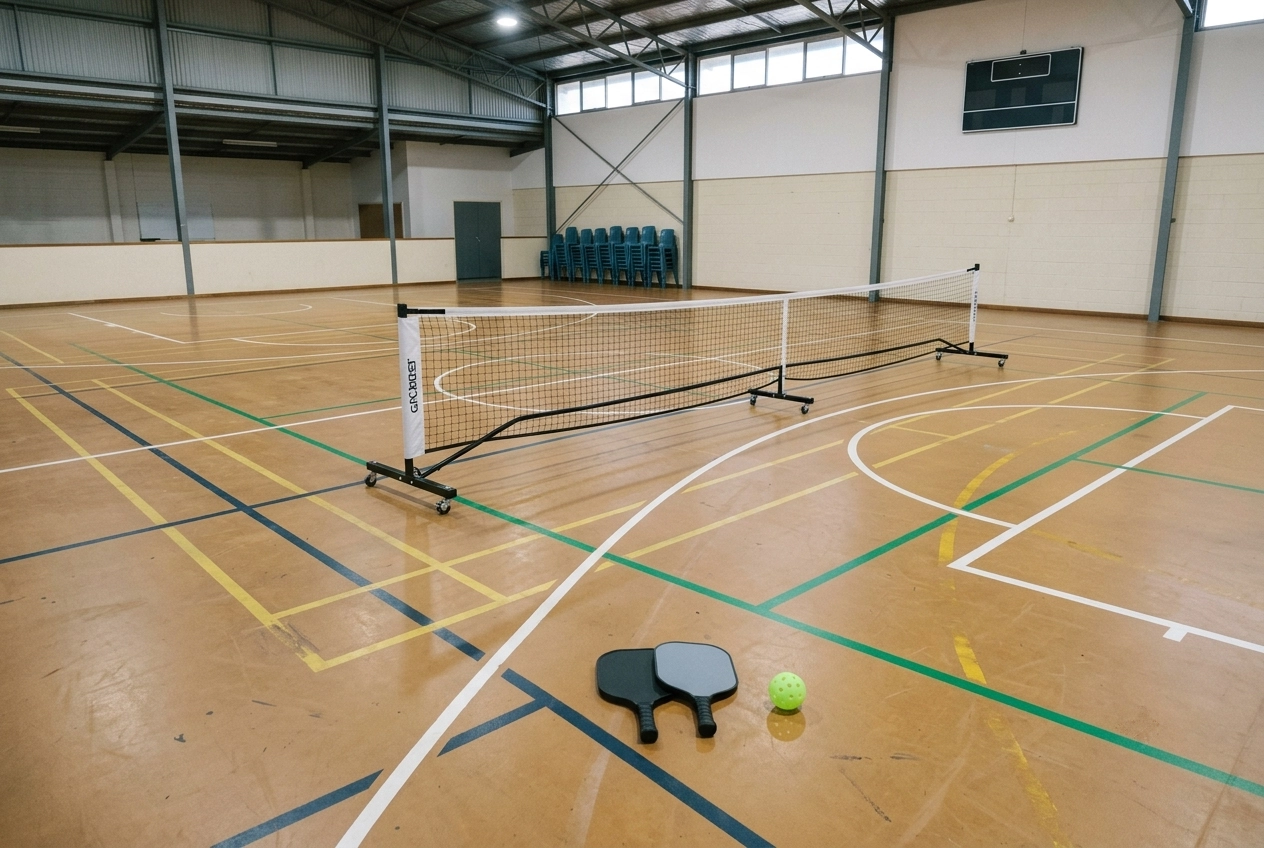
A pickleball court is 20 feet wide and 44 feet long (about 6.1 by 13.4 metres), the same dimensions used for both singles and doubles. The net sits 36 inches (91 cm) high at the sidelines and dips slightly to 34 inches (86 cm) in the centre.
The most important area to know is the non-volley zone, almost always called the kitchen. It is a strip extending 7 feet (2.13 m) back from the net on each side. You cannot hit the ball out of the air (a volley) while standing in this zone. We will come back to why that matters.
If you want the full measurements and how to mark out a court, see our guide to pickleball court dimensions and setup.
The equipment
You do not need much to start.
- Paddle: solid, with no strings, larger than a table tennis bat but smaller than a tennis racquet. Beginner paddles are inexpensive, and many venues hire them out for a few dollars a session (real examples below). Our how to choose a pickleball paddle article covers what to look for.
- Ball: a hollow plastic ball with holes, similar to a whiffle ball. Outdoor balls have smaller, more numerous holes and are slightly heavier than indoor balls.
- Shoes: court shoes with good lateral grip. Avoid running shoes, which are built for forward motion.
- Clothing: anything comfortable you can move in.
For a full beginner kit, have a look at pickleball gear essentials for beginners.
How a point works
This is where most newcomers get confused, so we will take it step by step.
The serve
The serve must be hit underarm, with contact made below your waist. You serve diagonally, from your right or left service area into the opponent’s diagonal service box, and the serve must clear the kitchen and land in that box. You serve from behind the baseline, and you only get one serve attempt (there is no second serve as in tennis).
The return
The receiving side lets the serve bounce once, then returns it. They too must let it bounce. This leads straight into the rule that defines the game.
The two-bounce rule
After the serve, the ball must bounce once on each side before anyone is allowed to volley. So the serve bounces, the return bounces, and only then can players start hitting the ball out of the air. This double-bounce rule stops the serving side from rushing the net and smashing the return, and it gives rallies a chance to develop.
The kitchen
Once the two bounces are done, play opens up, but the kitchen rule stays in force the whole game. You can step into the kitchen to play a ball that has bounced, but you cannot volley while standing in it, and you cannot let your momentum carry you into it after a volley. Stay behind that line when hitting out of the air and you will avoid the most common beginner fault.
A rally continues until someone faults: hitting the ball out, into the net, volleying in the kitchen, or breaking the two-bounce rule. For a fuller breakdown, read pickleball rules explained.
Basic scoring
Scoring trips up almost everyone at first, so keep it simple to start.
- Games are usually played to 11 points, and you must win by 2. In tournaments you may also see games to 15 or 21.
- You can only score a point when your side is serving. If the receiving side wins the rally, they do not get a point, they get the serve.
- In doubles, the score is called as three numbers: your team’s score, the opponents’ score, and which server you are (1 or 2). So “4 to 2, second server” tells everyone where things stand.
Do not worry about getting the call perfect on day one. Players are friendly about helping newcomers keep track. When you are ready to go deeper, pickleball scoring explained lays it all out.
A few quick tips for your first game
- Let serves and returns bounce. Forgetting the two-bounce rule is the number one beginner slip.
- Get to the kitchen line. Most points are won up near the net with soft, controlled shots, not from the baseline.
- Aim for control over power. A gentle shot that lands in beats a hard one that sails out.
- Call the score before each serve so everyone is on the same page.
For more on positioning and shot selection once you have the basics down, see pickleball strategy for beginners.
Getting started in Australia
The friendliest way in is a session built for first-timers, where the rules are taught on court and equipment is provided. These run under different names around the country, and a good share of the venues in our directory offer one. Some examples:
- Level Up Pickleball Knox City in Wantirna South, Melbourne, runs an Intro to Pickleball session plus dedicated beginner sessions on Tuesdays and Thursdays on its four indoor courts.
- Mosman Pickleball in Sydney offers The Launchpad, a four-week progressive beginner program of 12 sessions across Tuesdays, Thursdays and Saturdays, priced at $149.
- Pickleball Hervey Bay in Queensland holds a beginners session every Wednesday from 5:30pm to 7pm, with no registration required.
- Perth Pickleball Centre in Wanneroo runs Come and Try and Newbies sessions plus a novice social session on its nine indoor courts.
- Brisbane Bayside Pickleball Club hosts come-and-try sessions on Monday evenings from 7pm to 9pm at Wellington Point.
What a first visit costs
Less than most people expect. Club-run sessions are the best value: Pickleball Hervey Bay charges $10 per social session for non-members, or $5 once you join, and Brisbane Bayside is $11 for non-members and $6 for members. Commercial indoor centres sit a little higher; Perth Pickleball Centre, for example, charges non-members $14 for a 90-minute social session. Either way, your first game costs about as much as a takeaway lunch.
Borrow a paddle before you buy one
Do not buy a paddle for your first game. Look for venues that offer equipment hire and test the sport with theirs: Pickleball Hervey Bay hires paddles for $3 a session, and Level Up Pickleball Knox City charges non-members $5 while members borrow free. A few weeks on hire paddles will teach you far more about what you want than any review.
Clubs and associations
If you get hooked and want regular competition, the sport is organised nationally by the national governing body, Pickleball Australia (pickleballaus.org), which sits behind state bodies such as the Pickleball Association of NSW, Pickleball Queensland and Pickleball Victoria. WA, SA, Tasmania, the ACT and the NT have their own associations too. They run the leagues, tournaments and player ratings once social play stops being enough.
When you are ready, browse the full court directory or the interactive map to find a venue near you, then turn up, borrow a paddle, and get a rally going. The rules click into place faster than you would expect once you are actually on the court.