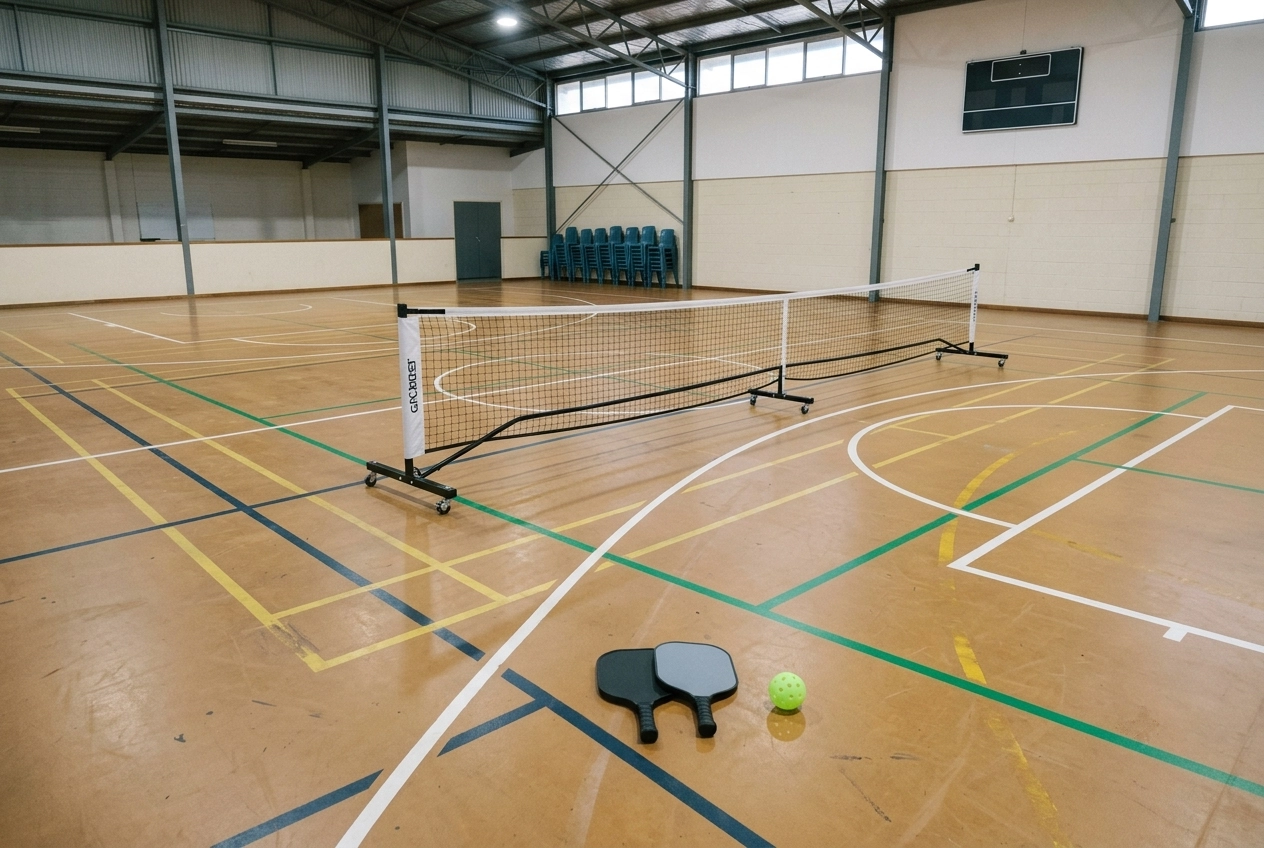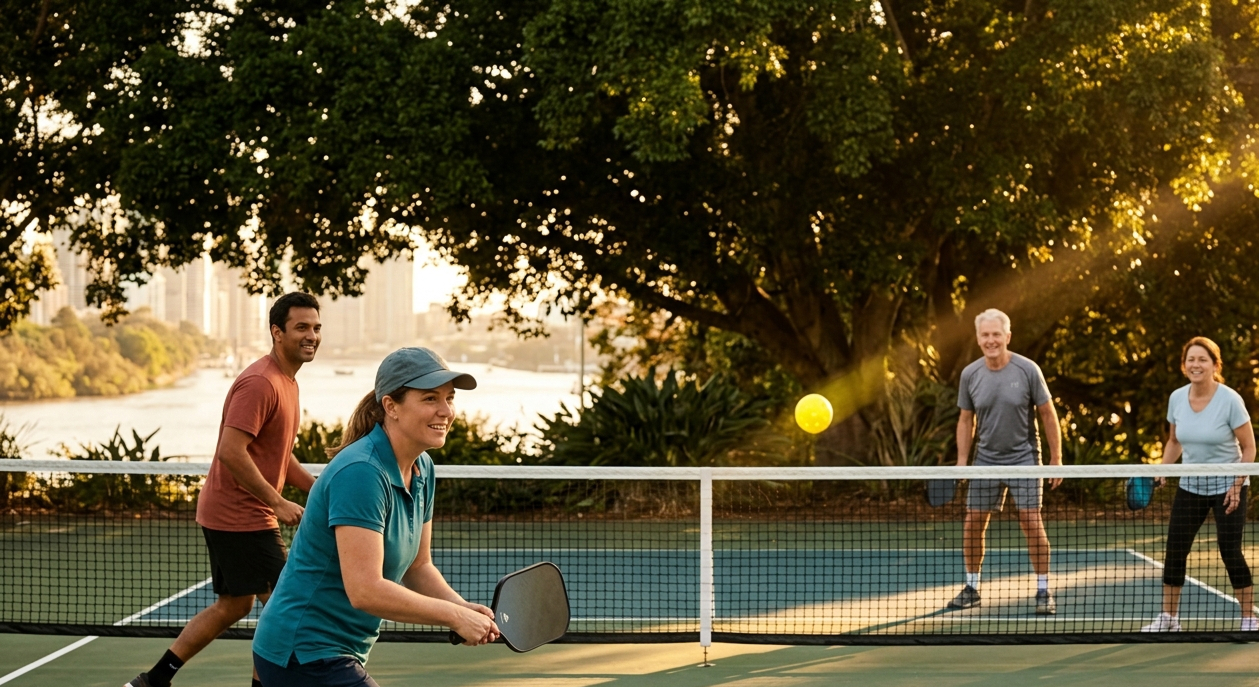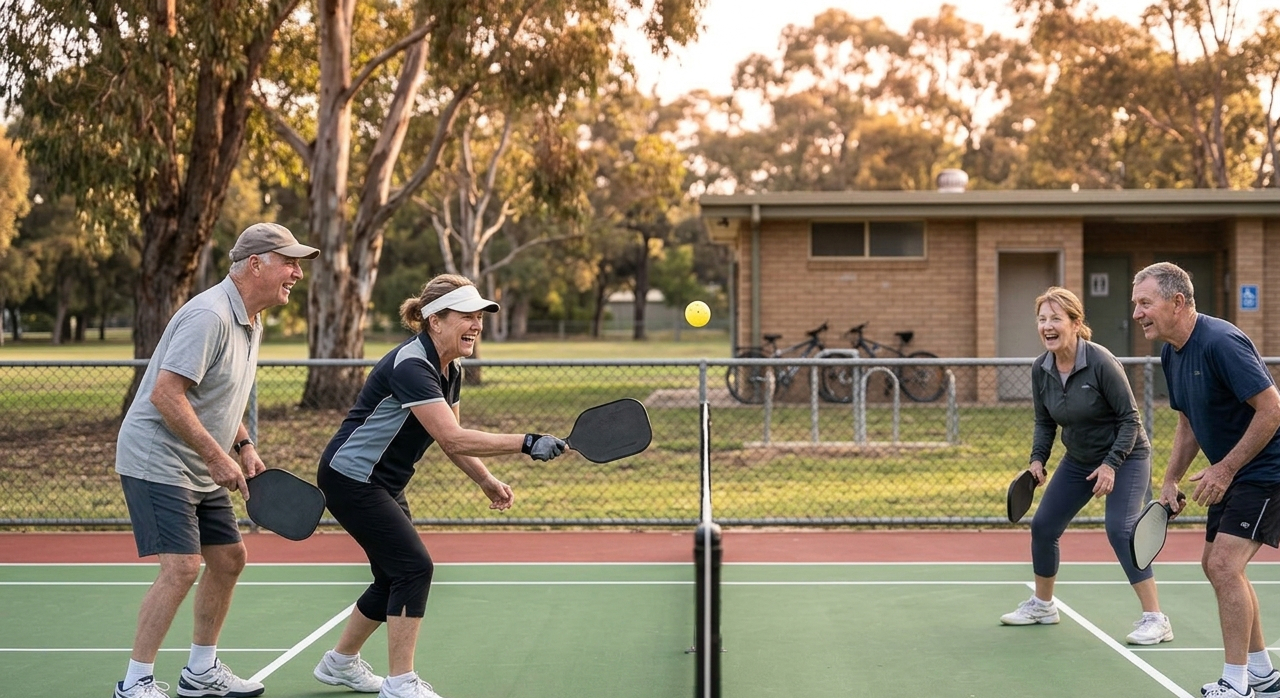

Pickleball and tennis look like cousins from a distance. Both are played over a net, both reward good footwork and timing, and both can be played as singles or doubles. Up close, though, they play very differently. In Australia they also increasingly share the same venues, which makes this comparison practical rather than theoretical: the club where you play tennis on Saturday may already run pickleball on Friday night.
Court size and layout
The clearest difference is the size of the playing area.
- A pickleball court is 20 x 44 feet (6.1 x 13.4 m), the same dimensions as a doubles badminton court.
- A tennis court is 78 feet long and 36 feet wide for doubles (about 23.8 x 11 m), roughly four times the area.
Pickleball uses one court size for both singles and doubles, so you cover far less ground. The net sits at 36 inches (about 91 cm) at the sidelines and dips to 34 inches (about 86 cm) at the centre, a touch lower than a tennis net.
Pickleball also has a feature tennis does not: the non-volley zone, universally called the kitchen. It extends 7 feet (2.13 m) back from the net on each side, and you cannot volley (hit the ball out of the air) while standing in it. That single rule shapes much of the strategy. For a full breakdown, see pickleball court dimensions and setup.
Equipment: paddle versus racquet
Tennis uses a strung racquet and a pressurised felt ball that bounces high and travels fast. Pickleball uses a solid paddle (no strings) and a lightweight perforated plastic ball that moves more slowly and bounces lower.
That has a few flow-on effects:
- Pickleball paddles are smaller and lighter than tennis racquets, which suits people who find a full-size racquet heavy or awkward.
- The plastic ball does not let you generate the same pace or topspin, so points rely more on placement, patience and touch.
- Start-up cost is lower, and you often do not even need your own paddle at first. Whittlesea Tennis & Pickleball Club in Victoria hires paddles for $5 a session with balls included, and UQ Sport Tennis Centre in St Lucia charges a $6 flat fee.
If you are choosing your first paddle, how to choose a pickleball paddle covers weight, grip size and materials.
Scoring and serving
Tennis scoring (15, 30, 40, deuce, advantage, then games and sets) is familiar but takes time to learn. Pickleball scoring is simpler in some ways and quirkier in others.
- Games are usually played to 11 points and you must win by 2. Tournaments sometimes use 15 or 21.
- In traditional pickleball, you only score points on your own serve.
- The serve is underhand (or a drop serve), struck below waist height, and it must travel diagonally into the opposite service court. It is far easier to learn than a tennis serve.
The rule that surprises most newcomers is the two-bounce rule. After the serve, the ball must bounce once on the receiver’s side, then once on the server’s side, before either team can start volleying. This stops the serving team from rushing the net early and keeps rallies longer. For the finer points, read pickleball scoring explained and pickleball rules explained.
Physical demands
Both sports build fitness, but they ask different things of you.
- Tennis covers a larger court, involves more sprinting and bigger swings, and puts more load on the shoulder, knees and lower back.
- Pickleball involves shorter, sharper movements over a smaller area. There is still plenty of lateral movement, lunging and quick reactions, but less long-distance running.
The smaller court and lighter equipment make pickleball gentler on the joints for a lot of people, which is part of why it appeals across a wide age range. It is not impact-free, though. Quick changes of direction can stress ankles and knees, and the volley exchanges at the kitchen are demanding on reflexes and balance. Warming up matters in both sports.
Learning curve
Pickleball is generally quicker to pick up. The court is smaller, the serve is straightforward, the ball moves slower, and you can hold a fun rally within your first session. Tennis takes longer to reach the point where rallies feel rewarding, largely because of the serve and the pace of the ball.
Skills do transfer. Tennis players arrive with good hand-eye coordination, footwork and an instinct for placement. The main adjustment is dialling back power, learning the soft game around the kitchen, and resisting the urge to take big tennis swings. New to the sport entirely? Start with how to play pickleball: a beginner’s guide.
How tennis clubs in Australia are adding pickleball
The two sports are not really competing for space here; mostly they are sharing it. Because a pickleball court takes up roughly a quarter of a tennis court’s footprint, a club can line an existing court and run pickleball with portable nets, or convert courts permanently. Plenty of Australian tennis venues have done exactly that:
- Queensland Tennis Centre in Tennyson, Brisbane, runs two dedicated hard courts for pickleball alongside its tennis facilities and hosts the Brisbane Pickleball Classic.
- Gosford Tennis Club on the NSW Central Coast now operates Gosford Pickleball Club on six courts, with a free introductory session (booked through the Voyager Tennis app), coaching, DUPR events and two 10-week night leagues, including a Monday league for 3.0+ DUPR players.
- Whittlesea Tennis & Pickleball Club in Victoria shares eight synthetic courts between the sports and runs social pickleball on Friday nights (7:30pm to 9:30pm) and Sunday afternoons (3pm to 5pm).
- Clifton Hill Tennis Club in Melbourne’s inner north shares six hard and synthetic grass courts, with social pickleball spread across five days of the week and a $10 drills session capped at ten players.
For a tennis player, this is the easy way in: your local tennis centre may already have marked lines, loan paddles and a weekly session. The habits carry over too, since most of these venues take bookings the same way they do for tennis courts.
What it costs to play
Court hire is where the economics of the two sports diverge, and the directory data makes it concrete. Some real pickleball prices, quoted as the venues list them:
- Whittlesea Tennis & Pickleball Club: $15 per hour per court for non-members, free for members (a social membership is $80 a year).
- Queensland Tennis Centre: $23 per hour off-peak and $26 per hour peak for non-members, with member rates of $19 and $22.
- Scoresby/Knoxfield Pickleball and Tennis Club in Melbourne’s east: $30 per hour from 9am to 4pm and $35 per hour from 4pm to 10pm across eight dedicated courts.
Hourly rates like these are often in a similar band to what venues charge for a tennis court. The difference is how the bill splits. Pickleball is overwhelmingly a doubles game, so that hourly rate is almost always shared four ways: at the venues above, that works out to roughly $4 to $9 per person per hour. A tennis court hired for singles splits between two people covering four times the area.
Hosted sessions are the other common format, priced per person rather than per court. Gosford Pickleball Club charges $20 per person for a hosted social session, or $15 per session if you buy a five-session pack. At UQ Sport Tennis Centre, students hire a pickleball court from $17 per hour off-peak. For a wider kit and cost rundown, see pickleball gear essentials for beginners.
Which should you choose?
Choose tennis if you enjoy long sprints, big swings and generating pace. Choose pickleball if you want something quick to learn, easier on the body and social by default, since you are sharing a small court with three other people and rotating partners at open sessions. Plenty of Australians do both, using pickleball as a lower-impact complement to tennis. If you get serious, the sport has its own structure here too, headed by the national governing body, Pickleball Australia (pickleballaus.org).
The best way to decide is to play. Browse every venue in our court directory, or use the interactive map to find the nearest court, whether it is a dedicated pickleball centre or a tennis club that has made room for the new game.